Mining
SOVEREIGN ANNOUNCES SUCCESSFUL REHABILITATION TRIALS AND COMMUNITY PARTNERSHIPS AT KASIYA
August 12, 2026 / Marcel Chimwala
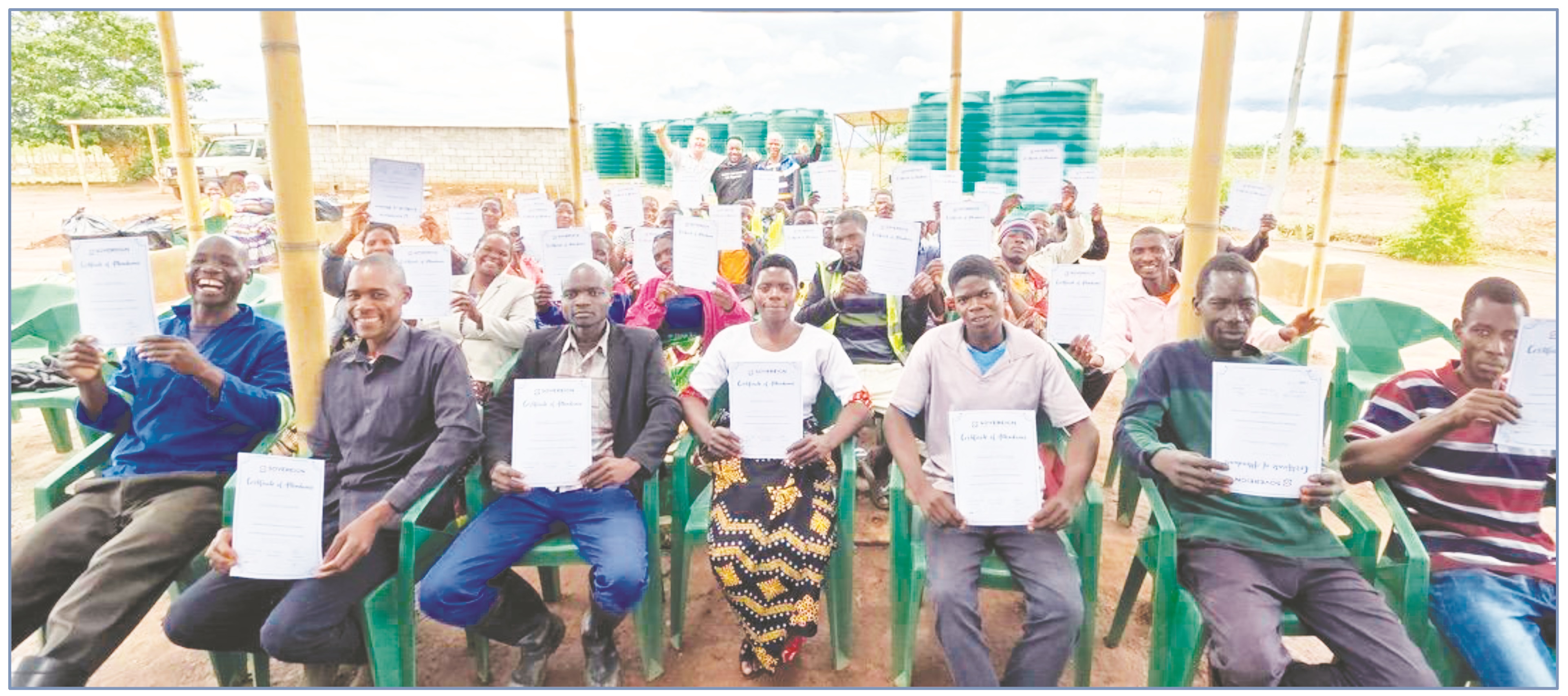
Sovereign Services has announced that its second year of rehabilitation trials being undertaken in support of the Kasiya Rutile-Graphite Project in Lilongwe is nearing completion during the upcoming harvest season.
The pilot mining, backfilling, and rehabilitation program is a key workstream and input into the Definitive Feasibility Study (DFS), which is being completed under the oversight of the Sovereign and its partnership with global mining giant Rio Tinto.
CEO and MD for Sovereign Services Frank Eagar explains that the rehabilitation trials provide practical, multi-year evidence of Sovereign’s alignment with international rehabilitation, environmental, and community good-practice standards.
Eagar says empirical data from the trials has been used to prepare the Mine Closure and Mine Rehabilitation Plans, which are now integrated into the mining, backfilling and post-mining closure planning – critical components for project bankability and alignment with the standards required by development finance institutions.
The rehabilitation trials demonstrate that all mined out pits can practically be backfilled and rehabilitated in a manner that allows farming to be reinstated quickly. This critical outcome proves that Sovereign can undertake mining while ensuring that all pits are safely closed and thereafter can support a sustainable post-closure land-use.
Eagar reports that the rehabilitation trials have also contributed to a significant community development outcome. After two years of close collaboration, the 28 local farmers involved in the trials have formally requested that Sovereign remains at the trial site and support them in establishing a farmer-based commercial farming co-operative. This represents a strong endorsement of the program’s value and is a central pillar of Kasiya’s social development strategy, demonstrating that the Project can deliver lasting economic benefits to local communities well beyond the mine life.
The outcomes directly complement the recently announced collaboration with the International Finance Corporation (IFC), a member of the World Bank Group, which is supporting integration of IFC Performance Standards into the Project’s DFS and Environmental and Social Impact Assessment (ESIA), and strengthening Kasiya’s pathway to bankable development and international project financing.
Eagar says: ““Sovereign’s primary objective is to deliver sustainable returns for all stakeholders, including shareholders and local communities. Not only will the overwhelming success and empirical data collected through this pilot mining and rehabilitation trial underpin the DFS accuracy, but it also demonstrates that land post mining can be successfully rehabilitated and our ability to improve agricultural productivity. The five-fold increase in maize yields will enable unprecedented and immediate secondary economic benefits. The emerging co-operative model is a practical example of our commitment in action – transforming mined land into more productive farmland while equipping local communities with the skills and infrastructure to thrive independently.”
Proven rehabilitation results
The second year of trials builds on the success of the first year, which delivered maize yields of 5.2 tonnes per hectare versus the regional average of 1 tonne per hectare – a fivefold increase that confirmed post-mining land can achieve superior agricultural productivity compared to pre-mining land.
Eagar explains that Sovereign’s rehabilitation approach is designed to use locally sourced agricultural inputs while maximising long term agricultural sustainability. Lime, fertilizer and biochar were applied during the first year of rehabilitation, with only targeted supplementation in the second year where specific deficiencies in basic nutrients were identified.
All rehabilitation activities were conducted under a no-tillage, minimal soil disturbance principle. No heavy machinery is permitted after final land-forming is done as part of backfilling. Thereafter, all soil remediation activities were undertaken by hand to preserve soil structure and the effectiveness of applied ameliorants. This simple, replicable approach is specifically designed to be adopted and maintained by local farming communities beyond mine closure.
Diversified Cropping System
The second year of trials has expanded the rehabilitation approach into a inter-cropping system, combining Maize with Giant Bamboo (Dendrocalamus asper). The first-year results confirmed that bamboo and maize co-exist with minimal competition, functioning in a symbiotic manner that supports long-term land productivity. Through the intercropping approach, local farmers were able to exceed their usual crop yields, while, in parallel, the Bamboo has been allowed to mature as a long-term carbon and soil remediation solution.
Sovereign also expanded the range of crops grown at the rehabilitation site, including the introduction of drip-irrigation winter crop farming program. The multi-cropping approach provides participating communities with a wider range of food, cash and fodder crops – supporting year-round agricultural viability and the transformation from subsistence to commercial farming on rehabilitated land.
Second-year crop yields are expected to reach, and potentially exceed, the first-year benchmark of 5.2 tonnes per hectare when harvested in mid-2026.
Community Partnership
Farmer engagement and participation are central to the long-term success of Kasiya’s rehabilitation strategy. The rehabilitation approach uses simple agronomic methods carried out largely by hand, ensuring that local communities can sustain and build on the improved farming practices beyond mine closure.
“Sovereign has worked closely with local farmers over the past two years, who have been integral to the success of the rehabilitation program. This deepening partnership has resulted in participating farmers formally requesting that Sovereign remains involved at the trial site and provide support in establishing a farming co-operative – a strong endorsement of the program’s value to the local communities. The development of community-led farming co-operatives forms a central pillar of Sovereign’s post-closure social transition strategy. The Company plans to continue working with local farmers throughout 2026, with a view to establishing a replicable model that can be scaled across the broader Kasiya project area as mining progresses,” says Eagar.
Share this:
Leave a Comment
Comments
Mining & Trade Review News

Agribusiness News
Subscribe to Newsletter
Rehabilitation:
The establishment of a stable and self-sustaining ecosystem, but not necessarily the one that existed before mining began. In many cases, complete restoration may be impossible, but successful remediation, reclamation, and rehabilitation can result in the timely establishment of a functional ecosystem.
Archives
Remediation:
The cleanup of the contaminated area to safe levels by removing or isolating contaminants. At mine sites, remediation often consists of isolating contaminated material in pre-existing tailings storage facilities, capping tailings and waste rock stockpiles with clean topsoil, and collecting and treating any contaminated mine water if necessary.
Stakeholders Logos